

Are Doctors Too Expensive in Dubai?
Dubai has some of the region’s most modern hospitals and clinics. The care can be fast, clean, advanced, and highly professional. But residents often ask the same question: why does a simple doctor visit feel so expensive? For many people, the real issue is not only the consultation fee. It is the full bill after insurance co-pay, lab tests, scans, medication, follow-ups, and referrals. Dubai’s healthcare system is strong, but residents need to understand how pricing works before they book the wrong clinic for the wrong problem.
Unpacking Dubai’s Healthcare System
Dubai has both public and private healthcare services. Government healthcare is available through Dubai Health, while private hospitals and clinics serve a large share of residents, expats, tourists, and insured employees. Private healthcare is often faster and more convenient, but it usually costs more. A premium clinic in Downtown Dubai or Dubai Marina may charge more than a neighborhood clinic in Deira or Al Qusais. A hospital outpatient department may also cost more than a small clinic for the same basic concern. Dubai health insurance is mandatory for residents. The Dubai Health Insurance Corporation manages the ISAHD system, which was created to support sustainable access to healthcare in Dubai. The official Dubai portal also states that health insurance is mandatory in Dubai and that employers are responsible for employee coverage, while sponsors must cover dependents, including spouses, children, and domestic workers.
What Residents Usually Mean by “Expensive”
When Dubai residents say doctor visits are expensive, they usually mean one of five things:
The consultation fee is high without insurance
The insurance network is limited
The co-pay adds up over repeated visits
Tests and scans cost more than expected
Medication is not fully covered
A general practitioner visit in Dubai may be lower than a specialist visit, but prices vary widely by clinic type and location. Some private sources list GP consultations around AED 150 to AED 300 and specialist visits around AED 300 to AED 500, while premium facilities may charge more. One Dubai clinic's fee structure lists a general practitioner consultation at AED 300, a specialist consultation at AED 585, and a consultant consultation at AED 650, showing how quickly prices can rise in higher-end settings. That range explains why two residents can have completely different experiences. One person may pay a small co-pay at an approved clinic. Another may pay several hundred dirhams out of pocket because the doctor is outside their network.
Why Specialist Fees Feel Higher
Specialist fees are one of the biggest reasons Dubai healthcare feels expensive. Dermatology, orthopedics, gynecology, cardiology, psychiatry, fertility care, dentistry, and advanced diagnostics often cost more than a standard GP visit. There are good reasons for some of the price differences. Specialists have advanced training, clinics invest in diagnostic equipment, and some treatments need longer appointments. But for the patient, the difference can still feel sharp. For example, someone with knee pain may start with a GP fee, then be referred to an orthopedic doctor, then need an X-ray or MRI, then physiotherapy. The original “doctor visit” becomes a larger treatment journey.
The Hidden Cost of Tests, Medication, and Admin Charges
Many residents focus on the doctor’s fee but overlook the additional costs that come after the consultation.
Cost Area | Why It Adds Up | What Residents Should Check |
|---|---|---|
Lab tests | Blood work may not be fully covered | Ask if approval is needed |
Imaging | X-rays, ultrasounds, and MRIs can be costly | Confirm insurance coverage first |
Medication | Some brands may not be covered | Ask for covered alternatives |
Follow-ups | Some clinics charge again | Ask if review is included |
Referrals | Insurance may require approval | Check network rules |
Admin fees | Files, reports, and forms may cost extra | Ask before requesting documents |
This is where many residents feel caught off guard. The doctor's fee may be manageable, but the full visit becomes expensive after tests and prescriptions.
Insurance Helps, But It Does Not Remove Every Cost
Insurance makes healthcare more accessible, but it does not always mean free healthcare. Most plans include limits, exclusions, networks, co-payments, approval rules, and annual caps. Some residents have strong corporate insurance that covers major hospitals and specialists. Others have basic plans with a smaller clinic network and higher out-of-pocket costs for certain services. From 1 January 2025, UAE employers must purchase a new health insurance policy when issuing or renewing residency permits for eligible employees through the DubaiCare Network or approved suppliers, according to MOHRE guidance. This improves access, but patients still need to understand what their specific plan covers.
Before booking, residents should check:
Is this clinic in my network?
Do I need pre-approval?
What is my co-pay?
Are lab tests included?
Is this doctor covered as a specialist?
Are medicines covered at the pharmacy?
Does my policy include maternity, dental, or mental health?
A quick insurance check before the visit can prevent a much bigger bill later.
Public vs. Private Healthcare Costs
Dubai’s private healthcare sector offers convenience, shorter wait times, polished facilities, and a wider range of clinic options. Public healthcare may be more affordable for eligible residents, but private care is often the default for insured expats. The choice depends on urgency, insurance, location, and medical need.
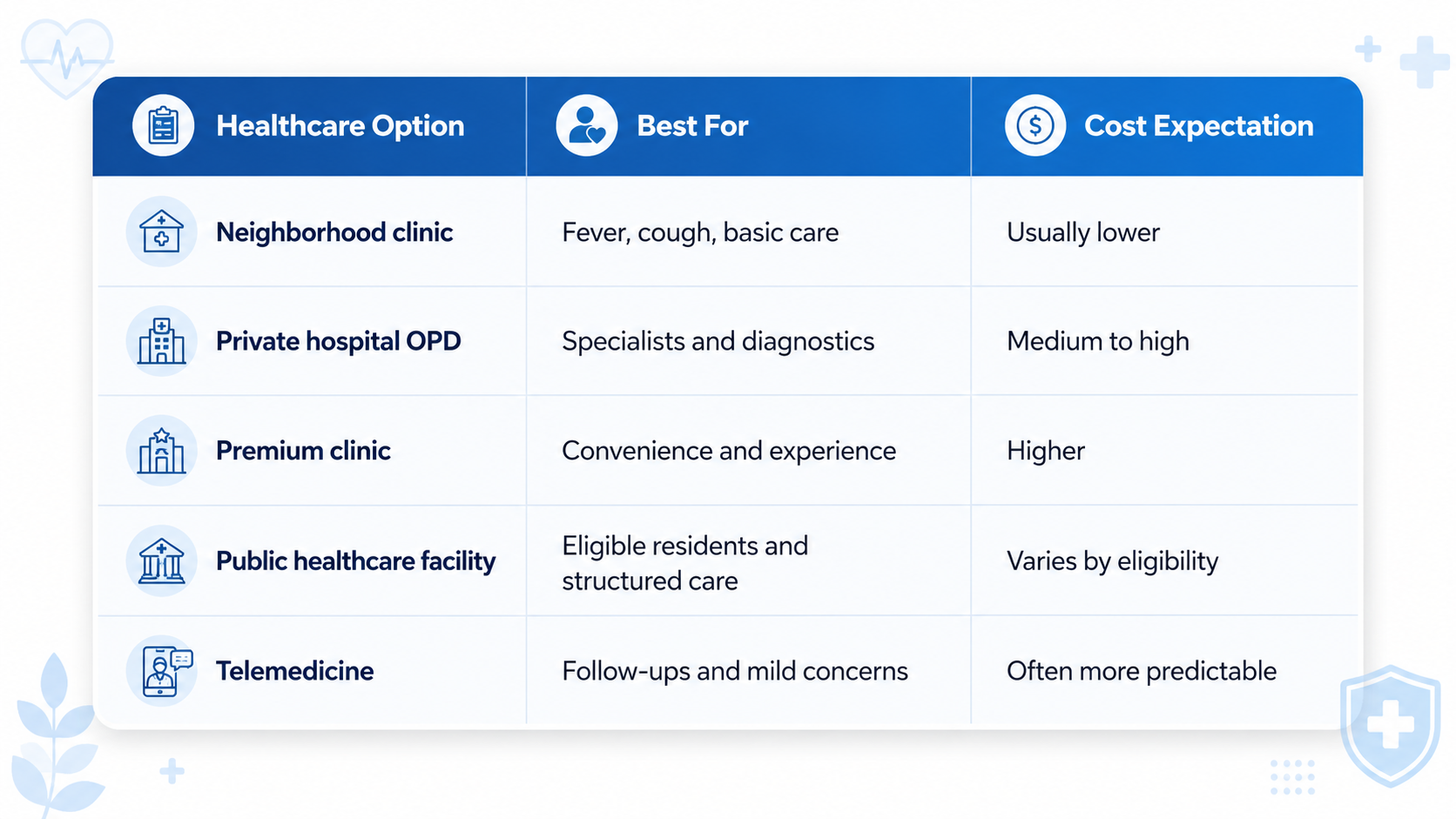
Healthcare Option | Best For | Cost Expectation |
|---|---|---|
Neighborhood clinic | Fever, cough, basic care | Usually lower |
Private hospital OPD | Specialists and diagnostics | Medium to high |
Premium clinic | Convenience and experience | Higher |
Public healthcare facility | Eligible residents and structured care | Varies by eligibility |
Telemedicine | Follow-ups and mild concerns | Often more predictable |
For routine care, a clinic is usually a smarter starting point than a hospital. Hospitals are useful when you need multiple services, emergency care, advanced imaging, surgery, or specialist teams.
Strategies for Managing Healthcare Expenses in Dubai
Residents can reduce medical costs by choosing care more carefully.
1. Start with a GP when symptoms are general
For fever, cough, stomach pain, headache, allergies, or mild infections, a general practitioner is often enough. Going straight to a specialist can cost more and may not be necessary.
2. Use insurance-approved networks
Do not assume every branch of a hospital group is covered. Check the exact clinic location and doctor category.
3. Ask about test costs before agreeing
If a test is not urgent, ask whether insurance approval is needed and whether a lower-cost diagnostic center is available.
4. Use preventive care
Annual checkups, blood pressure monitoring, diabetes screening, dental hygiene, and early treatment can help prevent costly complications later.
5. Compare clinics for routine care
A premium hospital is not always needed for common medical issues. Community clinics often provide good routine care at a lower cost.
6. Ask for generic medication options
When appropriate, ask the doctor or pharmacist if a covered or lower-cost equivalent is available.
Conclusion: Toward Sustainable and Affordable Healthcare
Doctors in Dubai can feel expensive, especially when patients use premium private facilities, visit specialists directly, or discover that tests and medicines are only partly covered. But the cost problem is not always just the doctor’s fee. It is the full care pathway. The smartest move is to match the healthcare setting to the medical need. Use clinics for routine care, hospitals for complex care, insurance-approved networks whenever possible, and telemedicine when suitable.
Frequently Asked Questions
Are doctors expensive in Dubai?
Doctors in Dubai can be expensive, especially in private hospitals, premium clinics, and specialist centers. Costs depend on the provider, location, specialty, insurance coverage, and required tests.
How much does a doctor consultation cost in Dubai?
A basic GP consultation may cost a few hundred dirhams, while specialist and consultant visits usually cost more. Prices vary widely, so patients should check the clinic fee before booking.
Is healthcare free in Dubai for residents?
Healthcare is not generally free for most expat residents. Residents usually rely on mandatory health insurance, employer coverage, or private payment.
Why are specialist doctors more expensive in Dubai?
Specialists charge more because of advanced training, higher demand, longer consultations, diagnostic needs, and the cost of running specialist facilities.
Related Posts

Top Doctors in Dubai: Marina, JVC, Deira & Downtown
Compare Dubai Marina, JVC, Deira, and Downtown Dubai to find trusted doctors, clinics, specialties, insurance options, and better medical care.

How Dubai Doctors Communicate With Diverse Patients
See how Dubai’s multicultural population changes doctor communication, patient trust, language support, consent, follow-ups, and healthcare access.